
Google is one of the most influential technology companies in the world, with leading businesses in online search, digital advertising, cloud computing, smartphones, video streaming, and artificial intelligence.
The Google share price target for 2026–2050 depends on how successfully its parent company, Alphabet Inc. (NASDAQ: GOOGL), protects its advertising business, turns AI investments into profits, and expands Google Cloud.
With Alphabet reporting strong revenue growth and increasing demand for its AI services, investors have reasons to remain optimistic, but high spending, competition, and regulatory pressure cannot be ignored.
This article examines the company’s financial performance, business strengths, valuation, technical outlook, and potential share prices through 2050 to help investors make better-informed decisions.
Contents
- 1. About Google and Its Parent Company
- 2. Key Points About Alphabet Stock
- 3. Company Fundamentals and Financial Strength
- 4. Technical Analysis of GOOGL Stock
- 5. Pros and Cons of Investing in Alphabet
- 6. Google Share Price Target 2026
- 7. Google Share Price Target 2027
- 8. Google Share Price Target 2028
- 9. Google Share Price Target 2029
- 10. Google Share Price Target 2030
- 11. Google Share Price Target 2035
- 12. Google Stock Valuation: Is GOOGL Expensive?
- 13. GOOGL Analyst Price Target and Wall Street Consensus Rating
- 14. Google vs Microsoft: Which Stock Has the Better Outlook?
- 15. Is GOOGL Stock a Buy at Current Levels?
- 16. Google Share Price Target 2040
- 17. Google Share Price Target 2045
- 18. Google Share Price Target 2050
- 19. Consolidated Long-Term Forecast: 2026–2050
- 20. Major Risks That Could Change the Outlook
- 21. Actionable Takeaways for Investors
- 22. Conclusion
- 23. FAQs
- 24. Author
About Google and Its Parent Company
Google was founded in 1998 by Larry Page and Sergey Brin. In 2015, the company became the central business under Alphabet Inc., a holding company created to manage Google’s established products and other technology investments.
Alphabet trades on the Nasdaq under two widely available stock symbols: GOOGL, which represents Class A shares with voting rights, and GOOG, which represents Class C shares without ordinary voting rights. Alphabet also has Class B shares, primarily held by company insiders.
Google’s main business is built around products that millions of people use every day. Google Search connects users with information, YouTube serves video viewers and advertisers, Android powers mobile devices, and Google Cloud provides computing and AI services to businesses.
The company’s size is a major advantage. According to its 2025 annual report, Alphabet generated approximately $402.8 billion in annual revenue in 2025, compared with $350.0 billion in 2024. That growth reflects the continued strength of its core advertising business, subscriptions, and cloud operations.
Alphabet is no longer simply an internet search company. It is building a broader technology business in which advertising, cloud infrastructure, AI models, digital subscriptions, and custom computer chips can support one another.
| Details | Information |
|---|---|
| Company Name | Google (Alphabet Inc.) |
| Business Sector | Google’s business operations, managed by its parent company Alphabet Inc., are structured into three primary sectors: Google Services, Google Cloud, and Other Bets. Google Services is the largest revenue driver, encompassing core internet products like Google Search, YouTube ads, the Android operating system, Chrome, Google Maps, and hardware like Pixel devices. Google Cloud delivers enterprise-level cloud infrastructure, cybersecurity, and data analytics tools alongside collaborative software like Google Workspace. Lastly, Other Bets acts as the company's innovation incubator, focusing on high-risk, "moonshot" ventures in emerging sectors, including autonomous transit via Waymo and advanced biotechnology research through Calico. |
| Stock Symbol | NASDAQ: GOOGL |
| NASDAQ Status | Listed |
| NSE Listing Status | Not Listed |
| BSE Listing Status | Not Listed |
| Official Website | www.google.com/ |
| Industry | Software & IT Services |
| Sector | Technology |
| Employees | 198933 |
| Market | United States |
Key Points About Alphabet Stock
Revenue Breakdown
Alphabet’s 2025 financial results show that advertising remains its largest source of revenue, while Google Cloud is becoming an important growth business.
| Business segment | 2025 revenue | Approximate share of total |
|---|---|---|
| Google Search and other | $224.5 billion | 55.7% |
| YouTube advertising | $40.4 billion | 10.0% |
| Google Network | $29.8 billion | 7.4% |
| Subscriptions, platforms and devices | $48.0 billion | 11.9% |
| Google Cloud | $58.7 billion | 14.6% |
| Other Bets and adjustments | $1.4 billion | 0.4% |
| Total Alphabet revenue | $402.8 billion | 100% |
Source: Alphabet’s 2025 Form 10-K. Figures are rounded.
Google Search remains the largest revenue contributor. However, Google Cloud, YouTube subscriptions, and paid services offer additional ways to grow beyond traditional search advertising.
The latest reported quarterly results also show strong momentum. In the second quarter of 2026, Alphabet’s revenue increased 24% year over year to $119.8 billion. Google Services revenue rose 15% to $94.5 billion, while Google Cloud revenue increased 82% to $24.8 billion. Operating income grew 30%, and the operating margin expanded to 34%.
These results, reported on July 22, 2026, are available in Alphabet’s official second-quarter earnings release.
Geographical Concentration
Alphabet operates internationally, but the United States remains its most important market. Its advertising business benefits from US consumer spending, business advertising budgets, and demand for digital services.
International markets provide significant opportunities, especially as internet access, smartphone use, online shopping, and digital payments expand. However, exchange-rate changes, local competition, data-protection rules, and differences in advertising demand can affect international results.
For long-term investors, geographic diversification is helpful, although it does not remove the company’s exposure to US regulation or global economic conditions.
Employee Base
Alphabet reported 190,820 employees at the end of 2025, according to its annual filing. Its workforce includes software engineers, AI researchers, cloud specialists, sales teams, cybersecurity professionals, and employees supporting consumer products.
This talent base helps the company develop new products and maintain large-scale infrastructure. At the same time, salaries, research spending, and competition for experienced AI specialists contribute to operating costs.
Products, Platforms, and Services
Alphabet’s main products include:
- Google Search: Online search and advertising.
- YouTube: Video advertising, subscriptions, and creator services.
- Android and Google Play: Mobile software and app distribution.
- Google Chrome: Web browsing and access to Google services.
- Google Maps: Navigation, local discovery, and business listings.
- Google Workspace: Gmail, Docs, Drive, Meet, and productivity tools.
- Google Cloud: Cloud computing, data analytics, cybersecurity, and AI infrastructure.
- Gemini: Google’s AI assistant and family of AI models.
- Pixel devices: Smartphones and other consumer hardware.
The value of this ecosystem comes from how these products work together. For example, a business might advertise through Search, analyze customer data using Google Cloud, and manage employees through Workspace. Such relationships can increase customer spending over time.
AI Developments, Expansion, and Partnerships
Artificial intelligence is one of the biggest factors shaping Alphabet’s long-term outlook. Google is integrating AI into Search, Gemini, Workspace, YouTube, and its cloud platform.
AI-powered search features could make Google more useful for complex questions, but they also create a financial challenge. If users receive answers directly on the results page, traditional advertising placements and website traffic patterns could change. Alphabet must show that its new search experiences can preserve or increase advertising value.
Google Cloud is another major opportunity. Its second-quarter 2026 revenue growth of 82% indicates rising demand for enterprise AI infrastructure and services. Continued expansion could make Cloud a more important source of profits, provided revenue growth eventually translates into healthy margins and cash flow.
Alphabet is also investing in custom AI chips, data centers, and energy supply.
In August 2026, Reuters reported a partnership involving Marvell Technology that could give Google an option to acquire a stake worth up to $12.2 billion under the announced chip-development arrangement. Such partnerships can broaden its supply options, although they do not eliminate the costs of developing AI infrastructure.
In February 2026, Alphabet announced that Intrinsic, its industrial robotics software business, would join Google to advance AI-enabled robotics. This move could support future opportunities in automation, although the financial benefits may take years to emerge.
Investors should separate announced investments and partnerships from revenue already earned. A promising project can create future growth without immediately increasing earnings per share.
Acquisitions and Recent Deals
Alphabet has used acquisitions, internal development, and strategic partnerships to expand its technology capabilities. Its investments span AI, cybersecurity, cloud services, robotics, and other emerging areas.
Its recent strategic direction includes:
- Integrating Intrinsic into Google to advance industrial robotics.
- Expanding AI infrastructure and custom-chip capabilities.
- Securing additional computing resources and energy capacity for data centers.
- Supporting AI research through partnerships with businesses, research organizations, and public institutions.
These initiatives can strengthen Alphabet’s competitive position. However, investors should monitor acquisition costs, integration risks, regulatory reviews, and the returns generated by capital-intensive projects.
Company Fundamentals and Financial Strength
Alphabet’s financial position is supported by its established advertising business, growing cloud operations, and ability to generate substantial operating cash flow.
In 2025, the company generated approximately $164.7 billion in operating cash flow and spent about $91.4 billion on capital expenditure, primarily for technical infrastructure. It also repurchased approximately $45.4 billion of its Class A and Class C shares during the year.
These figures matter because share repurchases can reduce the number of shares outstanding and support earnings per share, provided the company does not overpay for its stock. Strong operating cash flow also gives Alphabet resources to invest in AI, pay dividends, and maintain its competitive position.
Nevertheless, the spending required to build data centers and develop AI models is increasing. Investors need to track free cash flow—the cash remaining after capital expenditure—rather than focusing only on revenue growth.
The latest Google earnings report available for this analysis is the second-quarter 2026 release. Its 24% revenue growth and 30% operating-income growth are encouraging, but one quarter cannot guarantee future results.
Valuation also matters. The GOOGL P/E ratio compares its share price with its earnings per share. A high ratio can be justified when earnings grow rapidly, but it can also leave the stock vulnerable if growth slows or investors become less willing to pay a premium.
Alphabet pays a dividend, although its Google dividend yield has historically been modest compared with the yields of many income-focused stocks. Investors buying GOOGL primarily for long-term growth should consider dividends alongside earnings growth, share repurchases, valuation, and future cash generation.
For additional financial details, investors can review Alphabet’s SEC filings and investor relations website.
Technical Analysis of GOOGL Stock
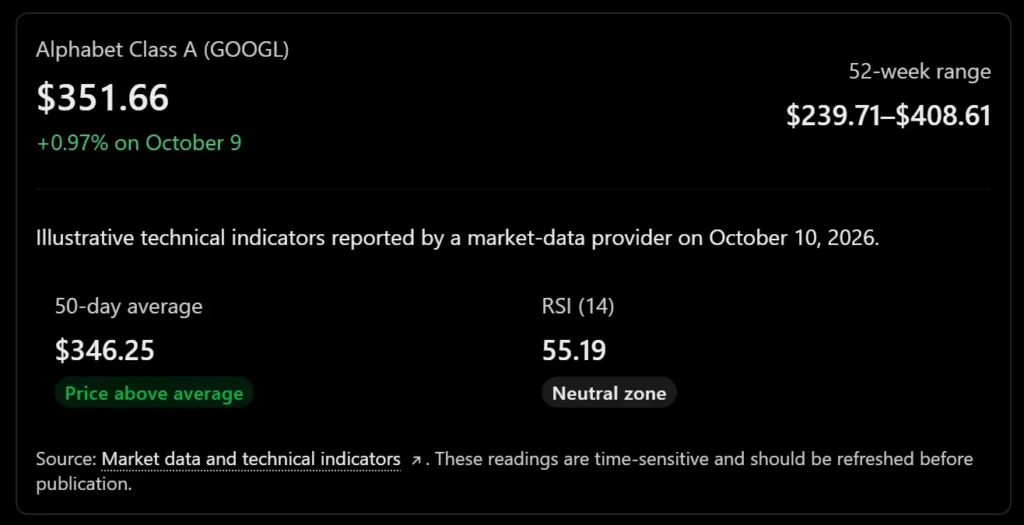
Market data reference: October 9, 2026 closing session.
Source: Market data and technical indicators. These readings are time-sensitive and should be refreshed before publication.
Technical analysis helps investors understand price momentum, possible support levels, and areas where selling pressure may emerge. It does not predict a stock’s future price with certainty.
The October 9 closing price of $351.66 was above the reported 50-day moving average of $346.25. The 14-day Relative Strength Index (RSI) was approximately 55, which is generally considered a neutral reading rather than an overbought or oversold condition. The stock remained below its reported 52-week high of $408.61.
Investors should watch the following levels as reference points, not guaranteed turning points:
- Near-term support: Around 340–346, based on the recent price area and reported 50-day average.
- Further support: Around $320, a potential psychological and price-area reference.
- Initial resistance: Around 375–380, where the stock would need to demonstrate renewed strength.
- Major resistance: Around 400–409, near the reported 52-week high.
A sustained move above resistance accompanied by strong trading volume could improve the technical outlook. Conversely, a decisive fall below support could indicate weakening momentum.
Technical signals should be considered alongside revenue growth, earnings forecasts, valuation, and developments in AI. A stock can remain technically strong while being expensive, or appear weak even when its long-term business outlook remains sound.
Pros and Cons of Investing in Alphabet
Advantages
- Dominant search business: Google has an established global presence and a large advertising ecosystem.
- Multiple revenue streams: YouTube, subscriptions, cloud computing, and devices reduce dependence on a single product over time.
- Strong cash generation: Operating cash flow provides resources for infrastructure, research, dividends, and share repurchases.
- AI growth opportunities: Gemini, AI-enabled Search, and enterprise AI services could support future revenue.
- Growing cloud business: Rapid growth in Google Cloud creates an opportunity to diversify earnings beyond advertising.
- Established consumer brands: Android, Chrome, Maps, Gmail, and YouTube help maintain engagement across Google’s ecosystem.
Disadvantages
- Advertising dependence: Search advertising remains a large portion of total revenue and is exposed to economic slowdowns.
- AI spending pressure: Data centers, advanced chips, energy, and AI research require significant investment.
- Regulatory challenges: Antitrust proceedings and changing rules could affect distribution agreements and business practices.
- Intense competition: Microsoft, OpenAI, Amazon, Meta, and other technology companies are competing for AI users, enterprise customers, and advertising budgets.
- Valuation risk: Even a strong business can produce disappointing investment returns if its stock price already reflects very optimistic expectations.
- Uncertain AI monetization: AI features must generate enough revenue or cost savings to justify their investment.
Google Share Price Target 2026
The 2026 outlook depends on whether Alphabet can maintain strong revenue growth while managing the rising cost of AI infrastructure. The second-quarter results provide a positive foundation, with revenue up 24% year over year and operating income up 30%.
However, the stock’s future performance will depend on full-year earnings, capital expenditure, and the market’s valuation of those earnings.
For this article, the following figures are independent scenario estimates, not official company guidance or a guaranteed outcome. They use the October 9, 2026 closing price of $351.66 as a reference and represent possible year-end price levels.
| Year | Low approx. | Average approx. | High approx. |
|---|---|---|---|
| 2026 | $300 | $380 | $430 |
The scenarios assume that Alphabet’s established businesses continue operating effectively, while the low case allows for weaker advertising growth, higher spending, or a valuation decline.
- Low case — $300: Search advertising slows, AI spending pressures free cash flow, or investors reduce the valuation they are willing to pay.
- Base case — $380: Advertising remains resilient, Cloud continues expanding, and earnings growth broadly supports the stock’s valuation.
- Bull case — $430: Strong earnings, improved AI monetization, and sustained investor demand lift the share price.
These estimates are for scenario analysis rather than a substitute for current analyst research. Investors should compare them with the latest earnings forecasts before making a decision.
Google Share Price Target 2027
The 2027 outlook will depend increasingly on how AI changes the economics of Google’s products. If AI-powered search experiences preserve advertising effectiveness and Google Cloud continues winning enterprise contracts, Alphabet could deliver further earnings growth. However, rising infrastructure costs or weaker returns on AI investment could limit gains.
The following estimates represent possible year-end 2027 outcomes, using the 2026 scenario as a starting point rather than assuming uninterrupted growth.
| Year | Low approx. | Average approx. | High approx. |
|---|---|---|---|
| 2027 | $290 | $420 | $490 |
- Low case — $290: Competition weakens search economics, regulation affects business arrangements, or capital spending weighs heavily on cash flow.
- Base case — $420: Search and YouTube remain profitable while Cloud and paid services contribute more to total earnings.
- Bull case — $490: AI products attract strong demand, Cloud expands profitably, and earnings growth supports a higher stock valuation.
The GOOGL price target 2027 should be reviewed as new financial results become available. A rising share price alone is not proof that the business is becoming more valuable; earnings and cash flow must support the move.
Google Share Price Target 2028
By 2028, Alphabet’s investment case could look different from its current advertising-led model. Google Cloud may contribute more significantly to profits, while Gemini and other AI services could create additional subscription and enterprise revenue.
At the same time, AI may change how users discover information, making the future economics of search an important factor.
| Year | Low approx. | Average approx. | High approx. |
|---|---|---|---|
| 2028 | $300 | $465 | $560 |
- Low case — $300: AI competition intensifies, search advertising growth weakens, or spending rises faster than profits.
- Base case — $465: Alphabet maintains healthy growth across advertising, cloud computing, and subscriptions, with earnings gradually catching up to its investments.
- Bull case — $560: AI products gain meaningful commercial traction, Cloud margins improve, and sustained earnings growth supports a higher valuation.
These long-range estimates are highly uncertain. Changes in interest rates, regulation, competition, and investor sentiment could produce outcomes outside the stated ranges.
Google Share Price Target 2029
By 2029, Alphabet’s performance will depend on whether it can turn its investment in artificial intelligence into lasting earnings growth. Its advertising business may remain a major source of cash, while Google Cloud, Gemini subscriptions, enterprise AI tools, and YouTube could contribute a larger share of revenue.
However, investors should not assume that every AI investment will succeed or that current profit margins will remain unchanged.
The following estimates are illustrative year-end scenarios for GOOGL Class A shares, not verified Wall Street forecasts. They assume that Alphabet continues to grow its core businesses while gradually improving the returns generated by its AI infrastructure.
| Year | Low approx. | Average approx. | High approx. |
|---|---|---|---|
| 2029 | $310 | $510 | $640 |
- Low case — $310: Search advertising faces sustained pressure, competition increases, or capital expenditure grows faster than operating cash flow.
- Base case — $510: Google maintains its advertising position, Cloud expands, and AI products contribute meaningfully to revenue without sharply reducing profitability.
- Bull case — $640: Alphabet successfully monetizes AI across search, productivity software, cloud computing, and consumer subscriptions, leading to stronger earnings growth.
Investors should also monitor the company’s share count. Share repurchases can increase earnings per share when the number of shares outstanding declines, but their benefit depends on the price paid and the company’s ability to fund buybacks without weakening its financial position.
Google Share Price Target 2030
The year 2030 is an important milestone for investors evaluating the long-term impact of AI on Alphabet. By then, businesses may use AI assistants more extensively for research, customer service, coding, advertising, and data analysis. Google could benefit from this change through Gemini, Google Cloud, Workspace, and AI-enhanced search.
However, the transition could also disrupt traditional internet search. If users increasingly rely on AI-generated answers instead of clicking through search results, Alphabet will need to develop effective advertising formats and other ways to earn revenue from those interactions.
| Year | Low approx. | Average approx. | High approx. |
|---|---|---|---|
| 2030 | $320 | $560 | $730 |
- Low case — $320: AI changes reduce the value of traditional search advertising, while regulation and infrastructure costs limit earnings growth.
- Base case — $560: Alphabet preserves a strong position in search, increases Cloud revenue, and earns more from AI services.
- Bull case — $730: AI becomes a substantial and profitable business across several Alphabet products, while advertising remains resilient.
These figures are nominal share-price scenarios, not estimates adjusted for inflation. They also assume no stock split that would change the quoted per-share price. Any stock split would change the share price and share count proportionately without directly changing the company’s total market value.
For investors planning to hold shares until 2030, the most useful question is not simply whether the stock can reach $560. It is whether Alphabet can increase its earnings and cash flow sufficiently to justify the market capitalization implied by that price.
Google Share Price Target 2035
A forecast for 2035 involves greater uncertainty than a forecast for the next year.
Over this period, Alphabet could benefit from broader adoption of AI, automated business processes, cloud computing, robotics, and digital services. It could also face new competitors, changing consumer behavior, stricter technology regulations, and higher costs for computing infrastructure.
The following scenarios illustrate possible outcomes if Alphabet remains a major technology company but experiences different rates of growth and valuation changes.
| Year | Low approx. | Average approx. | High approx. |
|---|---|---|---|
| 2035 | $350 | $800 | $1,150 |
- Low case — $350: Revenue growth slows substantially, AI disrupts important parts of the advertising business, or the market assigns a lower valuation to Alphabet’s earnings.
- Base case — $800: The company continues expanding its core businesses, develops profitable AI products, and maintains healthy long-term cash generation.
- Bull case — $1,150: Alphabet establishes leading positions in several AI markets, grows Cloud substantially, and delivers strong long-term earnings growth.
The range is intentionally wide because even a small difference in annual returns compounds significantly over nine years. A company that grows earnings consistently can still deliver disappointing shareholder returns if investors initially pay too high a price.
Investors should review Alphabet’s operating margins, return on invested capital, free cash flow, and competitive position periodically rather than relying on a single forecast published years in advance.
Google Stock Valuation: Is GOOGL Expensive?
Alphabet’s valuation is one of the most important factors to consider before investing. A strong business does not automatically make its shares a good purchase at every price. Investors need to compare the current share price with earnings, expected growth, cash flow, and the risks facing the company.
Three common measures can help evaluate the stock.
1. Price-to-Earnings Ratio
The price-to-earnings ratio, or P/E ratio, compares a company’s share price with its earnings per share. A higher ratio means investors are paying more for each dollar of current earnings.
For example, if Alphabet earns $10 per share annually and trades at $300, its P/E ratio is 30. If earnings rise to $12 per share while the share price remains $300, the ratio falls to 25.
This example shows why earnings growth matters. If Alphabet increases profits consistently, its valuation may become more reasonable even without a decline in the share price.
However, investors should distinguish between trailing and forward P/E ratios. Trailing P/E uses reported earnings, while forward P/E uses estimates that may prove inaccurate.
2. Free Cash Flow
Free cash flow measures the cash remaining after a company pays its operating expenses and capital expenditure. It is particularly important for Alphabet because building AI data centers and buying computing equipment requires substantial investment.
A company can report rising revenue and operating income while generating less free cash flow because of infrastructure spending.
Investors should therefore compare free cash flow over several quarters, examine capital expenditure guidance, and assess whether new AI investments are likely to generate returns above their cost.
3. Revenue and Earnings Growth
Alphabet has several potential growth drivers, including Google Cloud, AI services, YouTube subscriptions, and advertising improvements. The company has also introduced AI-based advertising features intended to help advertisers reach customers more effectively. Its official announcement about new AI-powered Search advertising formats explains how it is adapting advertising for conversational search experiences.
The central question is whether these new products can generate additional revenue without damaging the economics of established services.
A sensible valuation analysis should compare Alphabet’s expected earnings growth with its valuation multiple. Paying a premium can make sense for a company with strong growth, but paying too much can reduce future investment returns.
GOOGL Analyst Price Target and Wall Street Consensus Rating
As of October 10, 2026, recent analyst compilations indicate that Wall Street sentiment toward Alphabet remains positive. However, estimates vary between providers because they include different analysts, reporting dates, and target methodologies.
For example, MarketBeat’s analyst forecast reported an average target of approximately $425.72, based on 55 analysts. StockAnalysis reported an average target of approximately $429.47 from its analyst compilation. These are rolling 12-month targets, not forecasts for 2030 or 2050.
Using the October 9 closing price of $351.66, the difference between the share price and those average targets suggests potential upside of approximately 21%–22%.
That does not mean the stock will necessarily reach those levels. Analyst targets are estimates, not promises, and they can change quickly following earnings releases, regulatory developments, or changes in market conditions.
Investors should consider the following when reviewing analyst opinions:
- Target price: The analyst’s estimated share price over a stated period.
- Rating: Whether the analyst recommends buying, holding, or selling.
- Earnings estimates: The expected growth in earnings per share.
- Target revisions: Whether analysts are raising or reducing their expectations.
- Risks and assumptions: The business conditions needed to support the forecast.
A GOOGL upgrade or downgrade is more useful when investors understand the reasoning behind it. A price-target increase based on higher earnings estimates may carry more weight than one based only on a higher valuation multiple.
For the latest consensus figures, investors can also check Google Finance’s Alphabet analysis page.
Google vs Microsoft: Which Stock Has the Better Outlook?
Alphabet and Microsoft are both major beneficiaries of AI adoption, but their business models differ.
Business comparison as of October 2026.
| Factor | Alphabet (GOOGL) | Microsoft (MSFT) |
|---|---|---|
| Core strengths | Search, advertising, YouTube, Android | Windows, Microsoft 365, enterprise software |
| Cloud platform | Google Cloud | Microsoft Azure |
| AI opportunity | Gemini, AI Search, Cloud AI | Copilot, Azure AI, enterprise AI |
| Advertising exposure | High | Lower relative dependence |
| Key investment question | Can AI strengthen Search and Cloud profits? | Can AI investment deliver attractive returns across enterprise products? |
| Major risks | Search disruption, regulation, AI spending | AI spending, competition, enterprise demand, valuation |
Alphabet has a strong consumer ecosystem and a large advertising business that can generate cash for further investment. Microsoft benefits from established relationships with corporate customers and the ability to integrate AI into software that businesses already use.
Neither company is automatically the better investment. The choice depends on valuation, growth expectations, risk tolerance, and portfolio needs.
For example, an investor who believes AI will strengthen Google’s search business and increase enterprise demand for Google Cloud may prefer Alphabet. Someone who expects businesses to spend heavily on Azure and Microsoft 365 AI features may prefer Microsoft.
A useful comparison includes forward earnings growth, free cash flow, capital expenditure, operating margins, and the price investors must pay for each company’s expected profits.
Is GOOGL Stock a Buy at Current Levels?
At approximately $351.66 at the October 9, 2026 close, Alphabet offers a combination of an established advertising business and opportunities in cloud computing and AI. The latest reported quarterly results are encouraging: revenue rose 24% year over year to $119.8 billion, while operating income increased 30%. Google Cloud’s 82% growth is another positive sign.
Nevertheless, the investment decision depends on more than recent growth.
Alphabet faces a major test: it must show that AI spending produces lasting commercial returns. If AI improves search engagement, increases advertising effectiveness, and expands cloud revenue, the company could support further earnings growth. If costs rise faster than the revenue generated by AI, shareholder returns may disappoint.
Here is a practical way to approach the decision:
- Long-term investors: Consider whether Alphabet can grow earnings and free cash flow over five to ten years.
- Value-focused investors: Compare the forward P/E ratio and free cash flow yield with expected growth.
- Short-term traders: Watch technical support, resistance, trading volume, and upcoming earnings announcements.
- Income-focused investors: Remember that Alphabet’s dividend yield is relatively modest, so it may not suit investors seeking high current income.
- Risk-conscious investors: Consider gradual purchases rather than committing all available capital at one price.
My assessment is that Alphabet has attractive long-term business opportunities, but the stock should be judged against its current valuation and the returns its AI investments can deliver. A positive analyst consensus is useful context, not a replacement for independent research.
Google Share Price Target 2040
Forecasting Alphabet’s share price for 2040 requires looking beyond its current products and considering how technology, consumer behavior, and business spending may change over the next 14 years.
Google could benefit from wider AI adoption, advanced cloud computing, robotics, automated business services, and new digital products. Its existing search, video, mobile, and productivity platforms could provide a strong foundation for that growth.
However, Alphabet will need to keep innovating to protect its competitive position. New AI companies, changes in how people access information, antitrust action, and rising infrastructure costs could affect its long-term earnings. The following figures are illustrative scenarios for GOOGL shares at the end of 2040, not verified analyst estimates.
| Year | Low approx. | Average approx. | High approx. |
|---|---|---|---|
| 2040 | $380 | $1,100 | $1,700 |
- Low case — $380: Alphabet remains a large technology company but experiences slower growth, pressure on advertising profits, and lower valuation multiples.
- Base case — $1,100: The company expands its AI and cloud businesses while maintaining a profitable core advertising operation.
- Bull case — $1,700: Alphabet develops several successful AI and technology businesses, generates strong cash flow, and maintains healthy earnings growth over the period.
These scenarios show why investors should avoid treating long-term price targets as promises. The same company can produce very different shareholder returns depending on its earnings growth, starting valuation, and the market’s expectations.
Google Share Price Target 2045
By 2045, Alphabet’s business model may be significantly different from the one investors see today. AI assistants could become a standard way to search for information, complete work, shop online, and interact with software.
Cloud computing may also become more important as businesses require computing power for increasingly complex AI systems.
Alphabet could benefit if it owns or operates important parts of this technology ecosystem. Its established platforms, research capabilities, global distribution, and financial resources may help it compete. But those advantages will matter only if the company continues to deliver products that customers value and that generate sufficient returns.
| Year | Low approx. | Average approx. | High approx. |
|---|---|---|---|
| 2045 | $400 | $1,450 | $2,400 |
- Low case — $400: Competitive disruption and slower earnings growth limit the stock’s long-term appreciation.
- Base case — $1,450: Alphabet remains a leading technology company, with AI, Cloud, subscriptions, and advertising supporting long-term profitability.
- Bull case — $2,400: Several businesses achieve sustained growth, AI products become major profit contributors, and earnings compound strongly over time.
A high share price does not necessarily mean a stock has become expensive, just as a low share price does not automatically mean it is cheap. The company’s total market value, earnings, cash flow, and number of outstanding shares are more useful measures.
Investors should also remember that inflation will affect the purchasing power of future gains. A nominal share price of $1,450 in 2045 would not buy as much as $1,450 today.
Google Share Price Target 2050
The 2050 forecast is the most uncertain part of this analysis because it extends approximately 24 years beyond the current market date. Alphabet could become a much larger business if it successfully expands in AI, cloud computing, robotics, and other technologies.
Alternatively, new competitors or major changes in how people access digital information could weaken parts of its existing business.
The estimates below illustrate three possible outcomes rather than predicting a precise future price. They assume the same quoted share class and do not account for the effects of any future stock splits.
| Year | Low approx. | Average approx. | High approx. |
|---|---|---|---|
| 2050 | $450 | $1,900 | $3,400 |
- Low case — $450: Alphabet survives as an important technology business but delivers modest long-term earnings growth and faces recurring competitive pressure.
- Base case — $1,900: The company continues growing across several businesses, converts AI investments into profits, and maintains strong cash generation.
- Bull case — $3,400: Alphabet becomes a major beneficiary of AI-driven economic growth, develops several large new revenue streams, and compounds earnings at a strong rate for decades.
These estimates should not be interpreted as a promise that GOOGL will reach $1,900 or $3,400. The range is wide because a 24-year forecast is highly sensitive to assumptions about revenue, margins, reinvestment, valuation, inflation, and future competition.
For a more realistic long-term plan, investors should revisit their assumptions every year. Actual earnings, free cash flow, and competitive developments should take priority over a price target published today.
Consolidated Long-Term Forecast: 2026–2050
The following table brings together the illustrative year-end scenarios discussed throughout this article.
These are independent scenario estimates, not official Alphabet guidance or a verified consensus forecast. They are not based on a single discounted cash flow model, and the uncertainty increases substantially for dates beyond 2030.
| Year | Low approx. | Average approx. | High approx. |
|---|---|---|---|
| 2026 | $300 | $380 | $430 |
| 2027 | $290 | $420 | $490 |
| 2028 | $300 | $465 | $560 |
| 2029 | $310 | $510 | $640 |
| 2030 | $320 | $560 | $730 |
| 2035 | $350 | $800 | $1,150 |
| 2040 | $380 | $1,100 | $1,700 |
| 2045 | $400 | $1,450 | $2,400 |
| 2050 | $450 | $1,900 | $3,400 |
All values are in US dollars per share. The table assumes no stock splits and does not include dividends. Future share prices could fall below the low scenarios or exceed the high scenarios.
The gradual rise in the average scenarios reflects the assumption that Alphabet will grow its earnings over time. It does not mean that the share price will rise every year. Periods of falling prices, market corrections, and disappointing earnings are possible even when a company’s long-term business remains strong.
For example, a company can double its earnings but deliver a weak stock return if its valuation multiple falls sharply. Conversely, improving earnings combined with a reasonable valuation can support attractive returns.
Investors should therefore use these numbers as a starting point for their own analysis rather than as fixed buying or selling levels.
Major Risks That Could Change the Outlook
Before investing, consider the following risks that could materially affect Alphabet’s future performance.
- AI disruption of Search: AI assistants may change how people search for information. Alphabet must find profitable ways to serve users who increasingly expect direct answers instead of traditional lists of links.
- Higher capital expenditure: AI data centers, advanced chips, electricity, and networking equipment require substantial spending. If these investments fail to generate adequate returns, free cash flow could weaken.
- Antitrust regulation: Regulatory decisions in the United States and other countries could change distribution agreements, advertising practices, or the structure of parts of Google’s business. Investors can follow official case documents through the US Department of Justice.
- Competition: Microsoft, OpenAI, Amazon, Meta, and emerging AI companies are competing for users, advertisers, developers, and enterprise customers. Competition could increase costs or reduce margins.
- Economic conditions: Advertising budgets often respond to business confidence and economic growth. A recession could reduce demand for digital advertising even if Google’s market position remains strong.
- Valuation risk: Investors may already be pricing in significant AI growth. If actual results fall short of expectations, the share price could decline even when revenue continues to increase.
- Execution risk: New products, partnerships, and acquisitions do not always produce the expected financial benefits. Alphabet must turn research and investment into products that customers use and pay for.
Actionable Takeaways for Investors
Before buying GOOGL, use this checklist to assess whether the stock suits your investment goals.
- Review the latest earnings: Examine revenue growth, operating income, earnings per share, and management’s outlook.
- Check free cash flow: Compare cash generated with capital expenditure and share repurchases.
- Evaluate the valuation: Review the trailing and forward P/E ratios alongside expected earnings growth.
- Track Google Cloud: Look for evidence that rapid revenue growth is translating into improved profitability.
- Monitor AI monetization: Determine whether AI products generate additional revenue and improve customer retention.
- Follow regulatory developments: Assess whether new legal decisions could affect Google’s business model.
- Compare alternatives: Evaluate Alphabet against Microsoft and other technology companies on valuation, growth, and risk.
- Plan your entry: Consider staged purchases if you intend to invest over several years and want to reduce dependence on one entry price.
- Diversify your portfolio: Avoid concentrating too much of your investment capital in one company or sector.
- Review your thesis annually: Update your expectations as financial results and competitive conditions change.
For additional research, investors can use Alphabet Investor Relations, SEC company filings, and Google Finance.
You can also explore the stock analysis and calculator tools available at StockMarketor.com to help organize valuation assumptions and investment scenarios. Verify the availability and methodology of individual tools before relying on their results.
Conclusion
Alphabet remains an important company to watch as artificial intelligence changes how people search for information, businesses operate, and technology services are delivered. Its established advertising business, Google Cloud platform, YouTube ecosystem, and AI development capabilities provide several potential sources of future growth.
However, strong business performance does not guarantee strong investment returns at every purchase price. The company’s ability to monetize AI, manage infrastructure spending, preserve search profitability, and navigate regulation will be central to its long-term results.
The price scenarios through 2050 provide a framework for thinking about possible outcomes, not a promise of future returns. Investors should give greater weight to current financial results, valuation, cash generation, and changing business conditions than to any distant price target.
The bottom line: Alphabet may be worth considering for a diversified, long-term portfolio, provided its valuation is reasonable relative to expected growth and the investor can tolerate substantial volatility. Before purchasing shares, review the latest financial filings, compare the stock with alternative investments, and make a decision based on your own objectives, time horizon, and risk tolerance.
Disclaimer: This article is for educational and informational purposes only. The price scenarios are illustrative, not personalized investment advice or guaranteed forecasts. Stock prices can fall, and investors may lose some or all of their invested capital.
FAQs
What is the expected share price of GOOGL in 2026?
The illustrative year-end 2026 scenarios in this article range from $300 to $430, with an average scenario of $380. These are independent estimates rather than guaranteed outcomes or verified analyst consensus figures.
Actual performance will depend on earnings growth, AI spending, market sentiment, and valuation.
What is the expected GOOGL price in 2027?
The illustrative 2027 scenarios range from $290 to $490, with an average scenario of $420. Continued advertising strength and profitable expansion of Google Cloud could support growth, while regulatory pressure or weaker AI returns could limit it.
Can Alphabet stock reach $500 by 2030?
Yes, it is a plausible scenario, but it is not guaranteed. The average scenario presented here is $560 for 2030. Reaching $500 would require sustained business performance and a valuation that supports the resulting earnings expectations.
Can GOOGL reach $1,000 by 2035?
Alphabet could reach $1,000 by 2035 under a strong earnings-growth scenario. This article’s average scenario is $800, while its high scenario is $1,150. The outcome will depend on the company’s future profits, competitive position, and valuation.
Can Alphabet stock reach $2,000 by 2050?
A price of $2,000 is possible under favorable long-term assumptions, although this is highly uncertain. The average scenario in this article is $1,900, and the high scenario is $3,400. These figures should not be treated as reliable point predictions for such a distant date.
Is Google stock a good long-term investment?
Alphabet may suit investors seeking long-term exposure to digital advertising, cloud computing, AI, and consumer technology. Its established businesses and cash-generating capacity are important strengths.
However, investors must consider valuation, regulation, competition, and the risk that AI investments may not deliver expected returns.
Does Alphabet pay a dividend?
Yes. Alphabet introduced a cash dividend in 2024 and has made subsequent dividend payments. Its dividend yield has generally been modest, so investors should check the latest declared dividend and share price before calculating the current yield.
Details are available through Alphabet’s investor relations website.
What is the difference between GOOG and GOOGL?
Both symbols represent Alphabet shares traded on the Nasdaq.
GOOGL represents Class A shares with one vote per share, while GOOG represents Class C shares without ordinary voting rights. Their market prices can differ slightly, so investors should compare their current prices and liquidity before choosing between them.
What are the biggest risks of investing in Alphabet?
The main risks include disruption to traditional search from AI, rising infrastructure costs, antitrust action, stronger competition, and a valuation that assumes rapid growth.
A slowdown in advertising demand could also affect revenue and profits. Investors should monitor these risks alongside quarterly financial results.
How should investors estimate the fair value of GOOGL stock?
Investors can begin with forward earnings, expected earnings growth, the P/E ratio, and free cash flow.
A more detailed analysis may use a discounted cash flow model, which estimates the present value of future cash flows. Because the outcome depends on assumptions about growth, margins, capital expenditure, and discount rates, it is sensible to test several scenarios rather than rely on a single fair-value estimate.
Author
-
View all posts
Sachin Ramdurg, the Founder and CEO of AllStockShare.com, is an accomplished investor and entrepreneur with over 8 years of experience in stock market investing.
Coming from an engineering background, Sachin combines his analytical mindset with his passion for entrepreneurship and investment strategies to deliver unique and effective insights to the investing community.

Related posts:
 Amara Raja Batteries Share Price Target 2024, 2025, 2030, 2040, 2050 | Amara Raja Batteries Ltd
 Salasar Techno Share Price Target 2024, 2025, 2030, 2040, 2050 | Salasar Share Price Target
 Rattan Power Share Price Target 2024, 2025, 2030, 2040, 2050 | RattanIndia Power Share Price Target
 Salzer Electronics Share Price Target 2024, 2025, 2030, 2040, 2050 | Salzer Share Price Target
 Mazagon Dock Share Price Target 2024, 2025, 2030, 2040, 2050 | Mazagon Dock Shipbuilders Share Price Target
 Enviro Infra Share Price Target 2024, 2025, 2030, 2040, 2050 | Enviro Infra Engineers Share Price Target
 Apollo Tyres Share Price Target 2024, 2025, 2030, 2040, 2050 | Apollo Tyres Limited Share Price Target
 Microsoft (MSFT) Stock Price Target for 2026-2050: Bull, Base and Bear Cases